
The CBSE Curriculum: Excellence in Education
Our school follows the comprehensive and globally recognized curriculum prescribed by the Central Board of Secondary Education (CBSE), New Delhi. This curriculum is designed to provide a holistic education, emphasizing conceptual understanding, critical thinking, and real-world application, in alignment with the goals of the National Education Policy (NEP) 2020.
Key Features of the CBSE Curriculum
-
Holistic Development: Focuses on the physical, intellectual, social, and emotional growth of every student.
-
Competency-Based Learning: Shifts away from rote memorization towards acquiring competencies and applying knowledge to solve problems.
-
Experiential Learning: Integrates hands-on activities, projects, art, and sports to make learning engaging and relevant.
-
Focus on 21st-Century Skills: Actively promotes skills like critical thinking, creativity, collaboration, and communication.
-
Flexibility and Choice: Offers diverse subject combinations, particularly in the Senior Secondary stage, to cater to varied student interests and career aspirations.
🏫 Curriculum Stages (As per NEP 2020)
The curriculum is structured into the following four stages, ensuring a smooth and progressive learning journey:
| Stage | Grades | Typical Age Range | Core Focus |
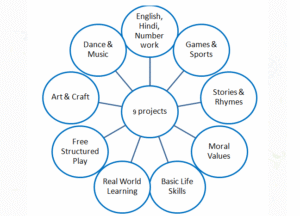
| Foundational Stage | Pre-Nursery to 2 | 3 to 8 years | Play-based learning, stories, developing early literacy and numeracy (L-N). |
| Preparatory Stage | 3 to 5 | 8 to 11 years | Formal introduction to reading, writing, speaking, mathematics, and environmental science through interactive classroom activities. |
| Middle Stage | 6 to 8 | 11 to 14 years | Introduction to more specialized subjects (Science, Social Science, Mathematics) with emphasis on hands-on projects and skills education. |
| Secondary Stage | 9 to 12 | 14 to 18 years | Deep conceptual learning, critical analysis, and preparing for higher education and career paths through Board Examinations and stream specialization. |
📖 Subject Structure by Level
I. Primary and Middle School (Classes 1 to 8)
The focus is on a broad and integrated curriculum that builds a strong foundation across core domains.
-
Core Academic Subjects: English, Hindi, Mathematics, Science (integrated up to Class 8), Social Science (History, Geography, Civics/Political Science).
-
Third Language: Introduction of a third language (e.g., Sanskrit, French, or a regional language) in the Middle Stage.
-
Skill Education: Emphasis on compulsory skill subjects for Classes 6-8, involving project-based learning in areas like coding, financial literacy, or basic trades.
-
Co-Scholastic Areas: Health & Physical Education, Art Education, and Work Experience/Seva (Community Service).
II. Secondary School (Classes 9 and 10)
This stage culminates in the All India Secondary School Examination (Class 10 Board Exam).
-
Compulsory Subjects: Two Languages (typically English and Hindi/Regional Language), Mathematics, Science, Social Science.
-
Optional Subject: Students choose one additional subject, which may include a Skill Subject (e.g., Computer Applications, Information Technology) or another academic subject.
III. Senior Secondary School (Classes 11 and 12)
This stage is crucial for higher education and career specialization, culminating in the All India Senior School Certificate Examination (Class 12 Board Exam). Students select a stream based on their aptitude and future goals:
| Stream | Core Subject Examples | Focus |
| Science | Physics, Chemistry, Biology, Mathematics/Applied Math | Prepares students for Engineering, Medicine, and pure science degrees. |
| Commerce | Accountancy, Business Studies, Economics, Mathematics/Informatics Practices | Prepares students for careers in Finance, Management, and Business. |
| Humanities | History, Political Science, Psychology, Sociology, Legal Studies | Prepares students for Civil Services, Law, Journalism, Design, and Liberal Arts. |
| Electives/Additional Subjects | Physical Education, Fine Arts, Multimedia, various Skill Subjects. |
📝 Assessment and Evaluation
Our assessment system reflects the CBSE's shift towards evaluating competencies rather than mere recall.
-
Continuous and Comprehensive Evaluation (CCE): Assessment is an ongoing process throughout the academic year, not just based on final exams.
-
Internal Assessment (20 Marks): For Board classes, 20% of the total marks are based on internal evaluation, including:
-
Periodic Tests
-
Subject Enrichment Activities (Practicals, Projects, ASL - Assessment of Speaking and Listening)
-
Portfolios and Notebook Submission
-
-
Board Examination (80 Marks): The year-end written examination conducted by the CBSE.
-
Focus on Practicals: Science and certain Commerce/Humanities subjects have mandatory practical examinations in Classes 11 and 12, emphasizing lab skills and application.